


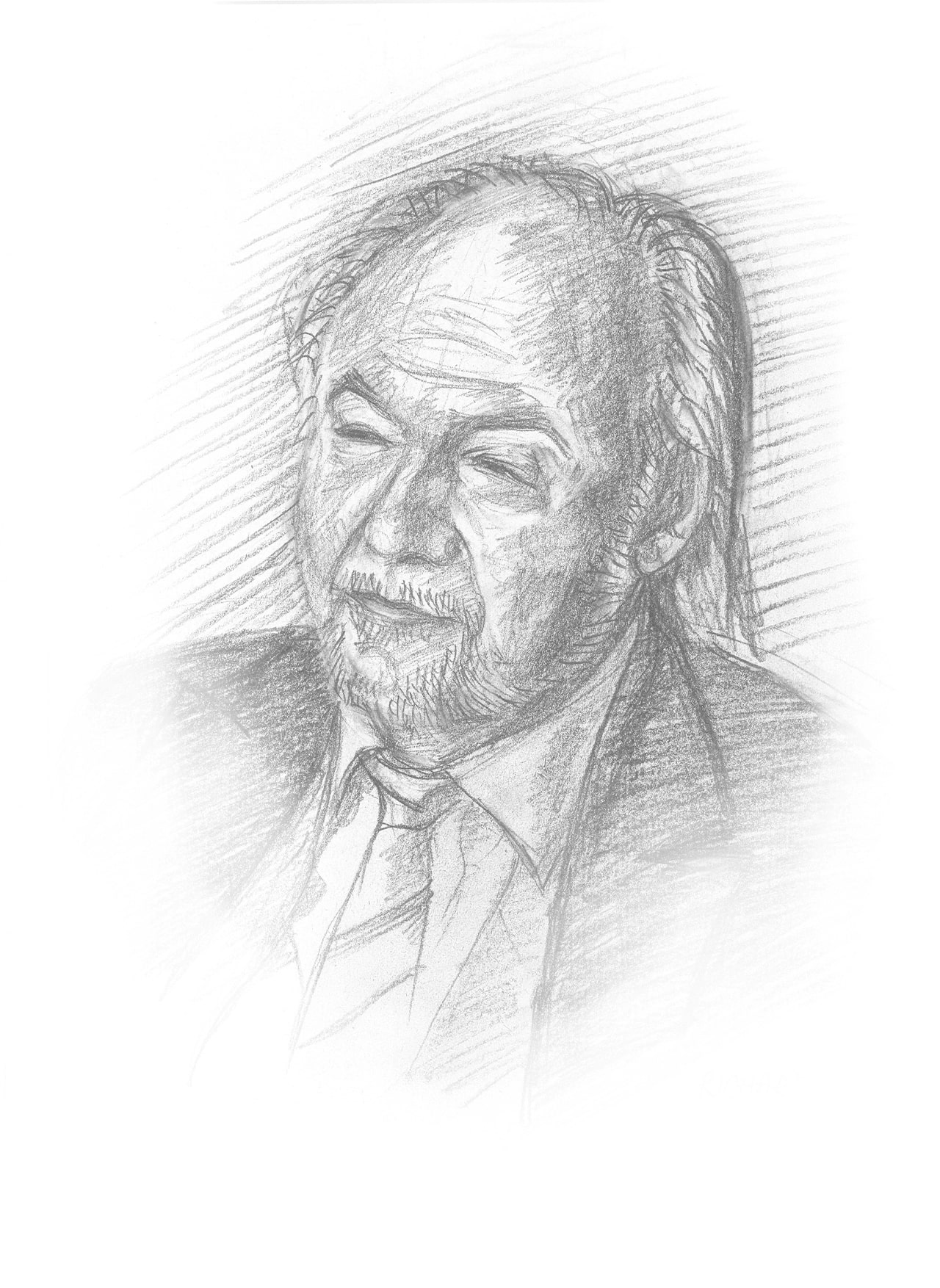
Richard Blanch
Staff 1975-201216 February 1949- 22 April 2025
 Richard Blanch and I shared a love of Charles Dickens’s novels. Even if we couldn’t quite agree on the merits of Our Mutual Friend ( which I still don’t enjoy, but which he judged a masterpiece) we were united in our admiration for Little Dorrit. Discussing it with him one day, I said “ Do you realize, Richard, that the two sisters, Fanny and Amy Dorrit, are really embodiments of Oxford and Cambridge universities ?” He laughed at my absurdity, but the point seemed valid. Fanny, worldly, extravagant, trifling and superficial, is an essential Oxonian: Amy, the ‘little Dorrit’ of the title, is serious, focused, discriminating and high-minded, the essence of Cambridge. Richard was very much of the latter kind, but never, thank God, a prig or a prude, his abiding sense of priorities as a teacher tempered by the thoroughly scabrous sense of humour that he somehow bred into all those he taught.
When he arrived at CLS the school gave him its customary baptism of fire. Would this quiet, mild-mannered intellectual survive the kind of bruising which various of us, me included, had gone through as a ritual induction ? Richard ‘stood the buffet’, to use a Shakespearean phrase, magnificently, because the boys soon grasped not just how serious he was about his work but how interested he at once became in them as people, in their individual resonances and evolving personalities. His wisdom as a teacher was to listen as much as to instruct, thus very quickly he gained his pupils’ enduring respect, settling in to CLS’s special rhythms, mastering its idiom and finding all this so congenial that he would stay with us for the whole of his teaching life.
Richard was an ideal colleague in the truest sense of that term. He worked with you all the way, his loyalty to you within the department was inflexible, he was notably void of meanness or self-seeking and completely uninterested in making a career out of his vocation. He looked out for others and went the distance even for people on the staff whom otherwise he hardly knew. He had his own marked sympathies and preferences, many of which I shared, though he never missed a chance to rap me over the knuckles ‘in the nicest possible way’ for being both a meat-eater and a Christian. Because he so rarely lost his temper or raised his voice, we might have thought he was happy to knuckle under and do as he was told, but Richard Blanch’s strength lay in his subversiveness. At certain points, as we all worked alongside eachother in the department down the years, I was reminded of that little scene in Julius Caesar where Octavius and Mark Antony are preparing for battle at Philippi against Brutus and Cassius. Antony says:
‘Octavius, lead your battle softly on/ Upon the left hand of the even field’
To which Octavius answers:
‘Upon the right hand I: keep thou the left’.
Antony then remonstrates:
‘Why do you cross me in this exigent ?’
‘I do not cross you,’ rejoins Octavius quietly, ‘but I will do so.’ Given Richard’s politics, which were largely mine too, he would have preferred the left, the spirit of Octavius’s response survived in him: ‘I do not cross you but I will do so’.
Richard had clear goals, both as to how he wanted to teach and whom he wanted to teach. That little room in the corner by the old English staffroom on Level 3 became a sort of private island, a small sovereign state, a refuge, a safe haven for so many of his students. His personal life outside school had given truly valuable perspectives on the Middle East and its culture. Whatever the staunchness of his atheism, he was sympathetic enough to Islam at its most humane and compassionate for Room 314 to become, at certain times in the day, a prayer hall for the devout among CLS’s Muslim pupils.
He was entirely ruthless, bless him, in selecting the members of his Sixth Form. Once assigned the departmental task of sorting out A Level English Literature sets, he quietly but resolutely ensured that his own class, regardless of what other teacher shared it, should bring together a choice selection of those blithe spirits who would bear his unforgettable imprint. I occasionally teased him about this pick-of-the-crop approach. “Of course it doesn’t work like that,” he’d say, “ it just depends on what other subjects they’re doing.” Well, ‘up to a point, Lord Copper’. Blanch’s Boys were unmistakable in their distinction, assumed like a kind of phosphorus from contact with his own ineffable brilliance.
Richard was himself a writer ( I was privileged with a glimpse of an enthralling novel set in Minoan Crete) His powers of analysis, his perceptiveness, his grasp of what honestly mattered in the text being read, made certain books, as far as I was concerned, untouchable or unteachable because they belonged so inalienably to Mr Blanch. King Lear was one of these, Villette and Wuthering Heights were others. On the single occasion when I ventured to teach Howard’s End I felt like a complete fake, because Forster essentially belonged to RSB.
It was all a kind of hidden wisdom, a cabala, a major arcana from which Blanch’s Boys emerged transfigured, the more because he so cherished them as individuals and loved the way they teased him with his own sensitivity to meaning and interpretation, so that Room 314 became a veritable academy of lethal jeux de mots and outrageous double-entendre. At no stage, even during the dreariest slog through the GCSE course, was Richard resigned to the dismal task of teaching to the syllabus. His classes knew they were getting something invaluably extra, and they rose to each lesson’s challenges as he dared them onwards.
CLS was kind to me during the four decades I spent there and part of this continuing good luck lay in having such a distinguished soul as a fellow teacher. For a final tribute to our dear and honoured RSB I can’t do better than remind you of the last lines of a novel by Thomas Hardy, a writer he enjoyed teaching. At the very end of The Woodlanders Marty South, mourning Giles Winterbourne, says “ Whenever I plant the young larches I’ll think that none can plant as you planted and whenever I split a gad and turn the cider wring I’ll say that none could do it like you. I never can forget you, for you was a good man and did good things”.
With thanks to Jonathan Keates, former English teacher, who delivered this tribute at Richard’s memorial in June 2025.
